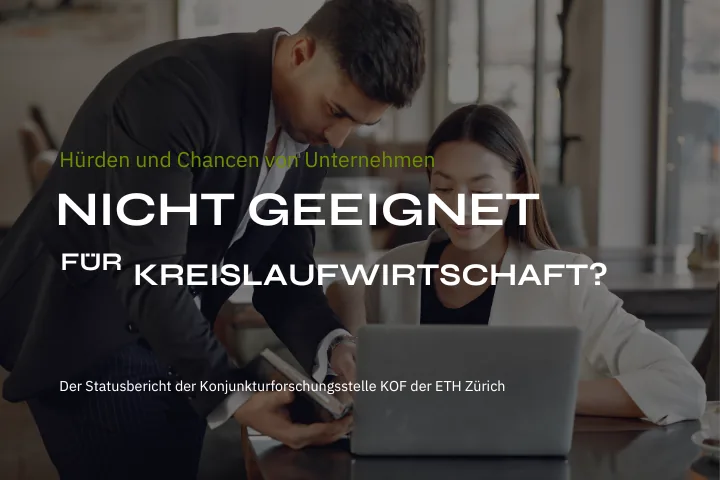
Not suitable for circular economy?
Potential of the Swiss circular economy
How far advanced are Swiss companies with regard to the circular economy? What are the most urgent fields of action? How can companies initiate or further develop circular economy in their own companies? And what hurdles do companies perceive?
At the beginning of 2022, the KOF economic research institute of ETH Zurich published the representative study Status Report of the Swiss Circular Economy , which, among other things, got to the bottom of precisely these questions. We summarize:
Opportunity for Swiss companies
The Swiss private sector is still at the beginning of the transformation process: between 8% and 12% of companies are substantially engaged in the transformation towards a circular economy.
In a nutshell: The study revealed that the Swiss circular economy is not yet very advanced. Although a circular economy is of great importance for Switzerland due to its limited resources, many companies are hesitant to act despite good preconditions. As one of the most innovative countries in the world, Switzerland would theoretically be able to implement circular measures. This is an opportunity for Swiss companies and for Switzerland's competitiveness in general to gain a comparative advantage. But what is holding us back?
The hurdles
The approximately 8000 companies surveyed for the study (response rate of 29.1%) named various reasons that prevent them from adopting the circular transformation. The greatest obstacle to implementing the circular economy in one's own company was seen as a lack of suitability.
Hurdles: "My product/service is not suitable".
On the one hand, based on current technological possibilities, many companies state that their products and services are not suitable for the circular economy. The greatest challenge here is therefore to make companies aware of sustainable solutions and to support them in finding innovative solutions that increase their "suitability".
Of the companies surveyed, 37% identified with the statement not suitable. They indicated that they perceived the circular economy as not suitable for their products or services. Companies see the lack of suitability ahead of investment costs (28%) and technical implementation (27% ) as the biggest hurdle for circular transformation in the company.
Implication for companies
According to the three most highly weighted hurdles from the perspective of companies, three central fields of action emerge from the study: Raising awareness of the circular economy among companies, reducing financial hurdles, and building knowledge to reduce technical hurdles.
Sensitization
There is a lack of opportunities and knowledge to adapt existing products and services to a circular economy. In order for efforts in this direction to be strengthened across the economy as a whole, there is a need for increasing awareness in the private sector as well as contributions to improving the knowledge base and innovative strength of companies.
Awareness-raising measures could address the biggest hurdle of lack of suitability . It is important to show why the circular economy not only benefits the environment, but also the company. It would also be necessary to dispel the fallacy that the company is not suitable for the circular economy.
In particular, it is important to reach companies that have so far been less aware, but also younger companies (start-ups), since circular business models are easier to implement when setting up a company than in established, linear companies.
Knowledge building
The results suggest that most companies have little experience with circular activities, and furthermore have limited ability to learn from other companies.
As one of the most innovative countries in the world, Switzerland has great potential. Swiss companies know how to transform knowledge into innovative products and services. The fact that circular solutions are still scarce today could be due to the lack of corresponding incentives (e.g. lack of demand or lack of knowledge base).
Educational programs can help companies overcome the technical hurdle and build up know-how. Circular competencies are to be taught, which would promote awareness of sustainability issues and also contribute to the circular design of business models.
Reduce financial hurdle
Often, small companies in particular can hardly overcome financial hurdles on their own.
With limited financial and time resources, the financial hurdle for companies plays an important role: getting started and expanding the circular economy can be a costly proposition, depending on the industry, the size of the company, and how far along a company is with its transformation.
While small companies generally have more difficulties overcoming financial hurdles on their own, companies with increasing size also have a more extensive need for investment in restructuring. Various actors such as Innosuisse promote circular innovation according to the principle of "bottum-up", i.e. innovation ideas that come from companies.
Summary
Due to Switzerland's innovative strength, the omens for the circular economy are good. Especially because of the limited resources available in Switzerland, the circular economy offers a great opportunity not only for the environment, but also for companies to gain competitive advantages. The status report on the Swiss circular economy shows that the companies surveyed perceive three major hurdles: They assume that circular economy is not suitable for their company, furthermore there is a lack of knowledge for the implementation and finally the investment costs keep them away from circular transformation.
With appropriate awareness and education measures, companies can lay a foundation for the circular economy. This can address the hurdles of lack of suitability and technical implementation. Economic policy support and cost-effective solutions can help overcome the financial hurdle.